
Penetration testing across six attack surfaces
Expert-led penetration testing for web applications, APIs, mobile apps, cloud environments, networks, and Wi-Fi. We combine hands-on testing with recognised OWASP, PTES, and NIST methodologies to uncover real risks and help you fix them.

Passeca delivers penetration tests across web applications, APIs, mobile apps, cloud environments, networks, and Wi-Fi to help you identify and address security risks. Each test follows a structured five-phase process based on recognised methodologies (OWASP WSTG, MASTG, PTES, and NIST SP 800-115), from vulnerability discovery to verified fixes. The result is a clear, actionable report that helps you improve security and support PCI DSS, ISO 27001, SOC 2, DORA, and NIS2 compliance.


- Web Applications
- APIs
- Mobile Apps
- Cloud
- Network
- Wi-Fi
Choose the systems you want to test
Every system has its own security risks. Our six penetration testing services follow recognised methodologies and focus on the vulnerabilities specific to each environment. Explore each service to see what we test, how we test it, example findings, expected timelines, and relevant compliance requirements.

Web Application
We test for OWASP Top 10 risks, including broken access controls, injection attacks, authentication flaws, and business-logic vulnerabilities.
- Broken access control
- Injection (SQLi/XSS)
- SSRF
- Authentication failures

API
Protect the connections your applications rely on. We test REST and GraphQL APIs for unauthorised access (BOLA), sensitive data exposure, unsafe data updates, rate-limiting weaknesses, and injection attacks.
- BOLA
- Excess data exposure
- Mass assignment
- Rate limiting

Mobile (Android / iOS)
Following OWASP MASTG, we assess data storage, encryption, certificate pinning, and how securely your app communicates and handles sensitive information.
- Insecure storage
- Certificate pinning bypass
- Insecure IPC
- Client-side trust

Cloud (AWS / Azure / GCP)
We examine permissions and access controls (IAM), publicly exposed services, containers, Kubernetes, and vulnerabilities that could reveal sensitive cloud information.
- IAM misconfig
- Exposed services
- Container / K8s
- SSRF to metadata

Network
We test internal and external systems for outdated services, weak credentials, lateral movement opportunities, and Active Directory privilege escalation.
- Unpatched services
- Weak credentials
- Lateral movement
- Domain escalation

Wi-Fi
We assess Wi-Fi encryption, rogue access points, Evil Twin attacks, and whether guest networks are properly isolated from critical systems.
- Weak ciphers (WPA2/3)
- Rogue APs
- Evil Twin
- Guest-network isolation
Penetration testing built on proven methodologies
We follow proven industry standards tailored to each system and clearly document our approach, so you know exactly what we test and how.
OWASP WSTG
Web applications
Web Security Testing Guide — the application-layer methodology.
OWASP MASTG
Mobile apps
Mobile Application Security Testing Guide — Android and iOS.
PTES
All asset types
Penetration Testing Execution Standard — the end-to-end engagement framework.
NIST SP 800-115
Network & systems
Technical guide to security testing and assessment.
See what a real pentest report looks like
What does a penetration test actually deliver? See for yourself. Explore a real, anonymised Passeca report with documented findings, supporting evidence, and practical recommendations to help your team fix what’s vulnerable.
Inside the sample report
No vague warnings or endless technical jargon. The report includes an executive summary, CVSS severity ratings, business impact, supporting evidence, reproduction steps, and clear remediation guidance for developers.
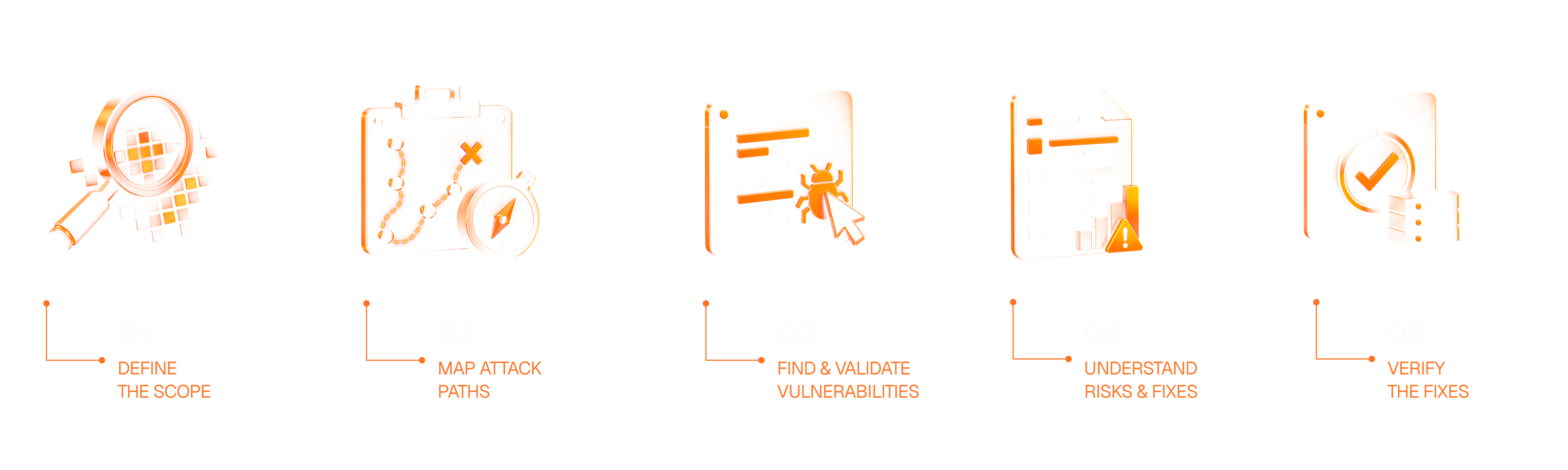
Your penetration test, explained in five steps
Our five-phase penetration testing process takes you from the initial scope to the final verification of fixes. Explore each phase to understand what we test, how we identify risks, and what results you can expect.
- 01
Define the scope
We agree on which systems to test, the relevant test types, success criteria, and testing schedule. We also establish clear authorisation and rules of engagement, so you know exactly what’s included and excluded before the test begins.
- 02
Map potential attack paths
We map your attack surface, including endpoints, services, identities, and trust boundaries, to understand where attackers could find a way in. We then build a threat model to focus our tests on the areas attackers are most likely to target. For cloud and network environments, we also identify exposed services and examine relationships between identities.
- 03
Find and validate vulnerabilities
We manually test for vulnerabilities according to recognised standards (OWASP WSTG, MASTG, PTES, and NIST SP 800-115). We assess individual weaknesses and how attackers could combine them to gain privileged access or reach sensitive data, which helps us identify the real business risks.
- 04
Understand the risks and how to fix them
We provide a detailed report that explains each vulnerability, its CVSS severity score, and its potential impact on your business. Your developers get evidence, steps to reproduce the issues, and practical recommendations for what to fix first. Your leadership and auditors also receive a clear executive summary.
- 05
Verify the fixes
Once your team addresses the findings, we retest the affected areas within the agreed engagement window to check that the vulnerabilities have been resolved. You’ll receive documented results to support your internal security and compliance efforts.
Tested by certified offensive-security engineers
Your security deserves more than a checklist. Our certified security specialists combine hands-on testing expertise with recognised industry qualifications to find and assess vulnerabilities that matter.


Penetration testing, answered
The most common questions about scoping, methodology, timing, cost and compliance.
What is penetration testing?
What methodology does Passeca use?
How is penetration testing different from vulnerability scanning?
How long does a penetration test take?
The timeline depends on the number, type, and complexity of the systems you need to test. A focused web application or API test may take a few days, while larger cloud or network assessments can take one to two weeks or longer. Use our free pentest scoping tool to get an initial time estimate.
How much does a penetration test cost?
The cost depends on the number of assets, their complexity, and the depth of the test. We calculate the price based on the estimated effort, whether the test uses a black-box, grey-box, or white-box approach. Our free pentest scoping tool gives you an initial time estimate and price range.
Which compliance frameworks require penetration testing?
Do you test black-box, grey-box or white-box?
Will a penetration test disrupt my production systems?
What does the report include?
What are the main types of penetration testing?
How do I know what to include in a penetration test?
Start with your most critical systems, sensitive data, and external entry points. The right scope depends on your infrastructure, business risks, and compliance requirements. Our free pentest scoping tool helps you define the assets to test and estimate the time and cost involved.
Does penetration testing use manual or automated techniques?
Is penetration testing suitable for small businesses and startups?
Get a time and cost estimate for your penetration test
Tell us which systems you need tested, and our free pentest scoping tool will estimate the time and cost. Passeca’s security experts will then review your requirements and provide a tailored quote.
Related